Commercial rotisserie ovens have been a staple in delis, supermarkets and rotisserie shops for decades. Seeing chickens rotating slowly under the heat while browning and dripping juices is a classic sight that attracts customers with its famous aroma. However, rising energy costs, labour pressures and the growing need to diversify and expand menus are forcing operators to ask themselves a crucial question: is it still worth investing in traditional rotisserie ovens, or are there more efficient, long-term alternatives?
A commercial rotisserie oven is designed to cook large quantities of meat evenly, using rotating spits positioned in front of a constant heat source. The heat is generated by burners or heating elements, while the rotation of the spits helps distribute the product’s fats more evenly while cooking. Achieving consistent results depends on careful control of loading, spacing and timing, which is why uniformity in product size and weight is often essential.
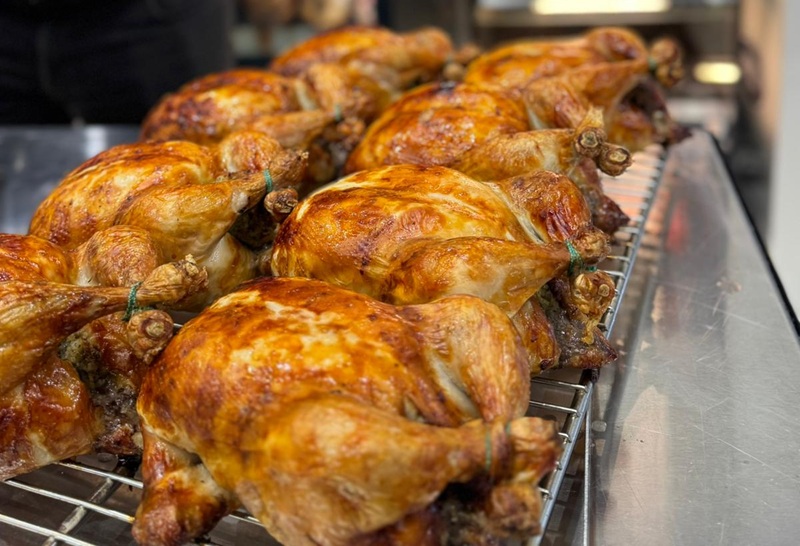
While rotisserie chicken remains a signature product, rotisserie ovens can also be used for other meats using cages or specialized spits. Options such as porchetta, pork knuckles or roasts can be successfully prepared when heat and rotation are properly managed. However, careful attention is required to prevent drying or uneven cooking, especially when different product types are cooked simultaneously. Unfortunately, this limits the oven’s efficiency and versatility, as it occupies significant kitchen space while offering few function ranges.
Despite their strong appeal, traditional rotisserie ovens present operational restrictions. They require significant dedicated floor space and usually dictate the kitchen layout, reducing flexibility for other equipment and workflows. Once the oven is being used, they are mostly single-purpose which limits a kitchen’s ability to shift production during service. Cleaning the ovens is labour-intensive due to accumulation of grease and residue on spits and internal components. While automatic washing systems do exist, they increase both the cost and equipment size. Safety is another concern, as staff must handle hot spits and exposure to hot fats, increasing the risk of burns, slips and injuries in fast-paced environments.
When commercial kitchens increasingly need to be flexible and efficient, rotisserie ovens can become a barrier to business growth.
Difference Between Combi Oven And Commercial Rotisserie Oven
In contrast, combi ovens use a combination of convection heat and steam to deliver far greater flexibility to deliver precise control over temperature, humidity and ventilation. This enables more consistent and repeatable cooking results across a wide range of products. Unlike rotisserie ovens, combi ovens support multiple cooking methods in a single unit, making them suitable for not only meats, but vegetables, baked goods, meals, snacks and more. If your business started with rotisserie chicken and you want to introduce new preparations now, a combi oven gives you the flexibility to do so without multiplying equipment, space and operational complexity. This versatility allows operators to expand menus without investing in additional specialized equipment.
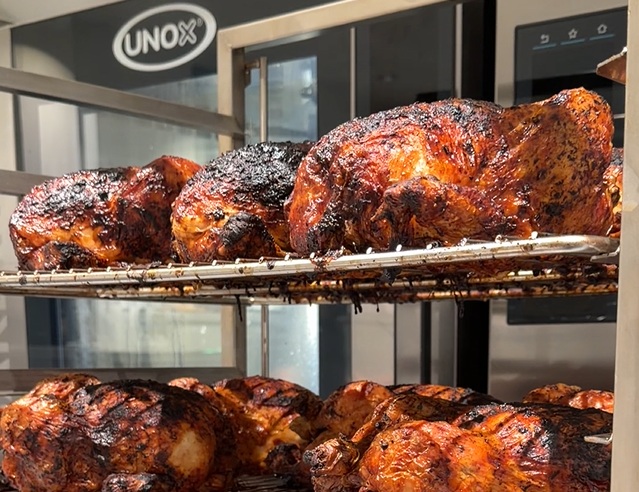
Unox offers advanced combi oven systems are designed to improve space utilisation, efficiency and productivity. Combi oven stacked solutions like the CHEFTOP range with GN 1/1 trays or the BAKERTOP range with 600x400 bakery trays that allow for a bigger yield, enable operators to maximise output across different production needs. Our stackable and vertical configurations further increase production capacity while maintaining a compact kitchen footprint. With the addition of a SMART.Drain that automatically collects grease and the automatic washing system integrated in Unox combi ovens, high hygiene is maintained easily. The intelligent SENSE.Klean technology will suggest the most suitable washing program based on the level of dirt, reducing manual intervention while ensuring consistent performance and reliability over time.
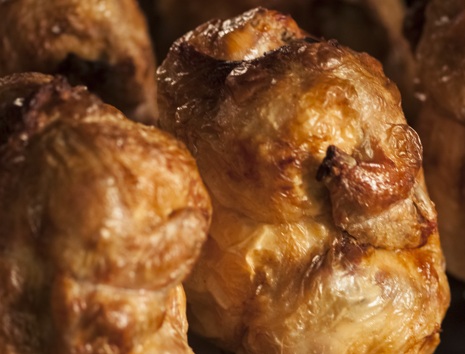
Ultimately, while traditional rotisserie ovens continue to offer strong visual appeal and results for rotisserie chicken production, their limitations in space, flexibility and maintenance make them less suited to a modern, fast-changing food service environment. Combi ovens provide a more versatile, efficient and consistent solution, allowing businesses to expand menus, optimize workflow and reduce operational constraints.