From the 1st of July 2026, NSW businesses that prepare, sell or handle food will be required to comply with new FOGO mandates. Businesses will be required to separate food organics from general waste. Non-compliance can result in fines of up to $500,000 & the rollout is staged by weekly waste capacity.
What is FOGO Legislation?
FOGO stands for Food Organics & Garden Organics. This encompasses all organic waste, including food waste such as fruit & veg, meat, dairy, bread, spoiled produce, and garden waste such as pruning, lawn clippings and leaves.
What is changing for NSW businesses?
The NSW Government has amended the Protection of the Environment Operations Act 1997 (NSW) and introduced the Protection of the Environment Legislation Amendment (FOGO Recycling) Act 2025 (often referred to as the FOGO Act). This requires businesses and institutions across NSW that handle or sell food to separate food and organic waste from general waste and have a dedicated food organics collection service. Essentially, businesses will need to stop putting food & garden organics into general waste bins. This includes supermarkets, hospitality businesses, food courts, food manufacturers, health care facilities, aged care providers, food trucks & other food service businesses. Waste collection providers provide FOGO collection services that businesses will be required to use to dispose of unwanted organics. This is a legal requirement under the NSW Environment Protection Authority and is not voluntary. Find out more on the NSW EPA website.

Who Must Comply First?
There will be a staged rollout targeting businesses that have the largest weekly waste volumes first.
- 1 July 2026: Businesses with 3,840 litres or more of general waste capacity per week must separate food organics from general waste. This captures hotels, large food courts, and major food manufacturers first.
- 1 July 2028: The threshold drops to 1,920 litres per week. This will require mid-sized restaurants, hospitality businesses, and institutional kitchens to separate their waste.
- 1 July 2030: The threshold is further reduced to 720 litres per week. This captures most commercial kitchens and smaller food businesses in NSW. By this date, all local councils must also provide weekly FOGO collection services to households.
If businesses are found to be non-compliant with the NSW FOGO mandate, they risk fines of up to $500,000. Preparing now will minimise potential disruptions to workflows, waste disposal disruptions, operating efficiencies & allow appropriate time for staff training.
If you’re not sure how much waste your business produces each week, this helpful cheat sheet can create a better perspective. Alternatively, reach out to customerservice@rewardh.com.au to speak to an expert.
| Bin Type |
Typical Capacity |
Equivalent to 3,840L/week |
Visual Description |
| Wheelie Bin (Household) |
240L |
≈ 16 x 240L bins |
Equivalent to approximately 16 standard 240L wheelie bins of waste per week, representing the weekly volume threshold for sites captured under the 2026 mandate. |
| Commercial Front-Lift Bin |
660L |
≈ 6 x 660L bins |
Comparable to around six large commercial front-lift bins, commonly used by restaurants, supermarkets and other high-volume businesses. |
| 2m³ Skip Bin |
2,000L |
≈ 2 x 2m³ skip bins |
Similar to filling two small 2 m³ skip bins each week. This volume aligns with how the NSW EPA identifies large food waste generators for July 2026. |
| 3m³ Skip Bin |
3,000L |
≈ 1.3 x 3m³ skips |
Roughly equivalent to one full 3 m³ skip bin plus an additional third of a skip each week. |
| 4.5m³ Hook Bin |
4,500L |
≈ 0.85 x 4.5m³ hook bin |
Just under the capacity of one medium 4.5 m³ hook-lift bin per week. |
Recommended Systems for Separating Organics & Ensuring Compliance:
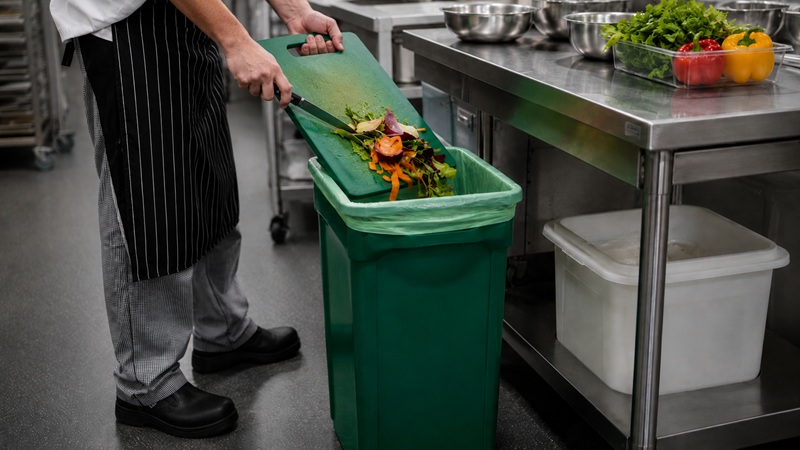
Kleaning Essentials Svelte Bins are colour coded green, making it easy to identify bins designated for organic waste. These bins provide a durable, hygienic waste system for collecting & separating food organics. The sleek design helps them fit in tight spaces, both front & back of house. Using compostable bin bags such as Earth Essentials compostable bin bags keeps bins mess free & allows for easy waste collection. Together, these two products reduce contamination, improve staff efficiency, and create an organised waste management system that’s FOGO compliant.
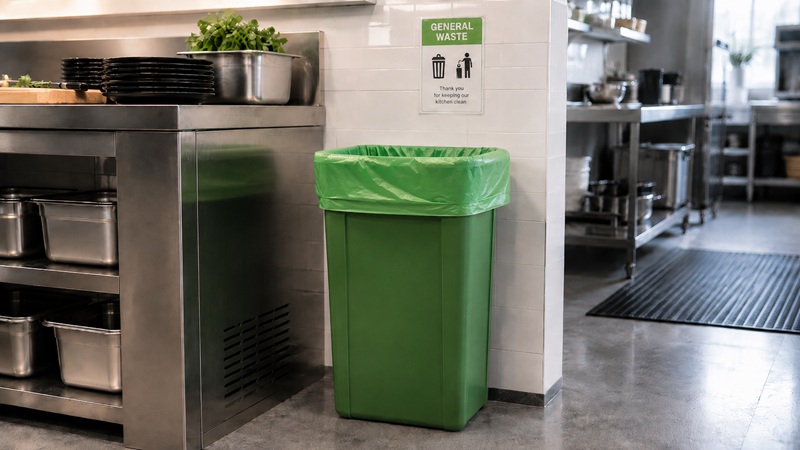
These items can be easily purchased online through Reward Hospitality & set up as recurring orders for easy bin bag replenishment.
Your NSW FOGO Compliance Checklist
Use this simple checklist to help prepare your business for the upcoming NSW FOGO requirements.
- Understand your compliance date
Determine whether your business falls into the 2026 rollout or a later phase based on your weekly general waste volume.
- Review your current waste practices
Assess how much food waste your business generates and where it is produced throughout your operation.
- Introduce dedicated FOGO bins
Place clearly labelled food organics bins in food preparation, service and waste disposal areas.
- Choose certified compostable bin liners
Use compostable liners where accepted by your waste provider to support cleaner, more efficient food waste collection.
- Arrange a FOGO collection service
Speak with your waste service provider to ensure a dedicated food organics collection is in place before your compliance date.
- Train your staff
Make sure your team understands what belongs in food organics, recycling and general waste to minimise contamination.
- Use clear signage
Label every waste station consistently to make waste separation simple for staff and customers.
- Review your collection schedule
Food waste may require more frequent collection than general waste to maintain hygiene and minimise odours.
- Order your FOGO supplies early
Avoid last-minute delays by purchasing bins, compostable liners and waste accessories before demand increases.
Need help getting compliant?
Don’t risk non-compliance & potential fines. Reward Hospitality has everything you need to prepare for the NSW FOGO rollout, including commercial food waste bins, colour-coded waste systems and certified compostable bin liners. Shop our range today or talk to an expert and be ready before your compliance deadline.
Frequently Asked Questions (FAQs)
What does FOGO stand for?
FOGO stands for Food Organics Garden Organics and refers to organic materials such as food scraps & garden waste that are collected separately from general waste. This enables them to be processed into compost & recycled instead of being sent to landfill.
What is the FOGO business mandate in NSW?
The NSW FOGO business mandate requires businesses and institutions that handle or sell food to separate food waste from general waste and arrange a dedicated food organics collection service. The requirements are being introduced in stages from 1 July 2026, with larger businesses required to comply first based on their weekly general waste bin capacity.
When do the NSW FOGO laws start?
The new NSW FOGO legislation comes into effect from 1 July 2026. There will be a staged rollout with businesses producing 3,840L/week or more of waste to comply first. The threshold will be lowered to 1,920L/week in 2028 and 720 litres/week in 2030.
What happens if my business isn’t compliant?
If a business is found non-compliant after 1st July 2026, they risk receiving fines of up to $500,000. Compliance action may be taken by NSW EPA or local councils including inspections, audits & enforcement.
Is FOGO mandatory for all NSW businesses?
Not immediately. The FOGO mandate is being rolled out in stages based on how much general waste a business produces per week. Only businesses that handle or serve food will be required to comply.
What food waste systems do I need for FOGO compliance?
Businesses should set up & begin using:
- Dedicated food organics bins that are colour-coded for easy identification, such as Kleaning Essentials Svelte Green Bins.
- Certified compostable bin liners (where accepted by your waste provider), like Earth Essentials compostable bin bags.
- Clear waste signage and labels
- Staff training on correct waste separation
- A dedicated food organics collection service arranged through a waste provider
Can I use normal plastic bin liners?
No. Plastic bin bags are not biodegradable & will not be allowed. Certified compostable bin bags, such as Earth Essentials Compostable Bags, are the perfect alternative, as they can be processed with organic waste.